
What’s Really in Your Bottled Water? (Nanoplastics Explained) | Houston Water Test
Find out what’s really in your water.
🌐 Visit Our Website
Agenda tu prueba de agua GRATIS:
What’s Really in Your Bottled Water?
When you grab a bottle of water, you expect purity, safety, and refreshment. But recent studies reveal something surprising: bottled water may contain microscopic plastic particles you can’t see.
The Shocking Discovery
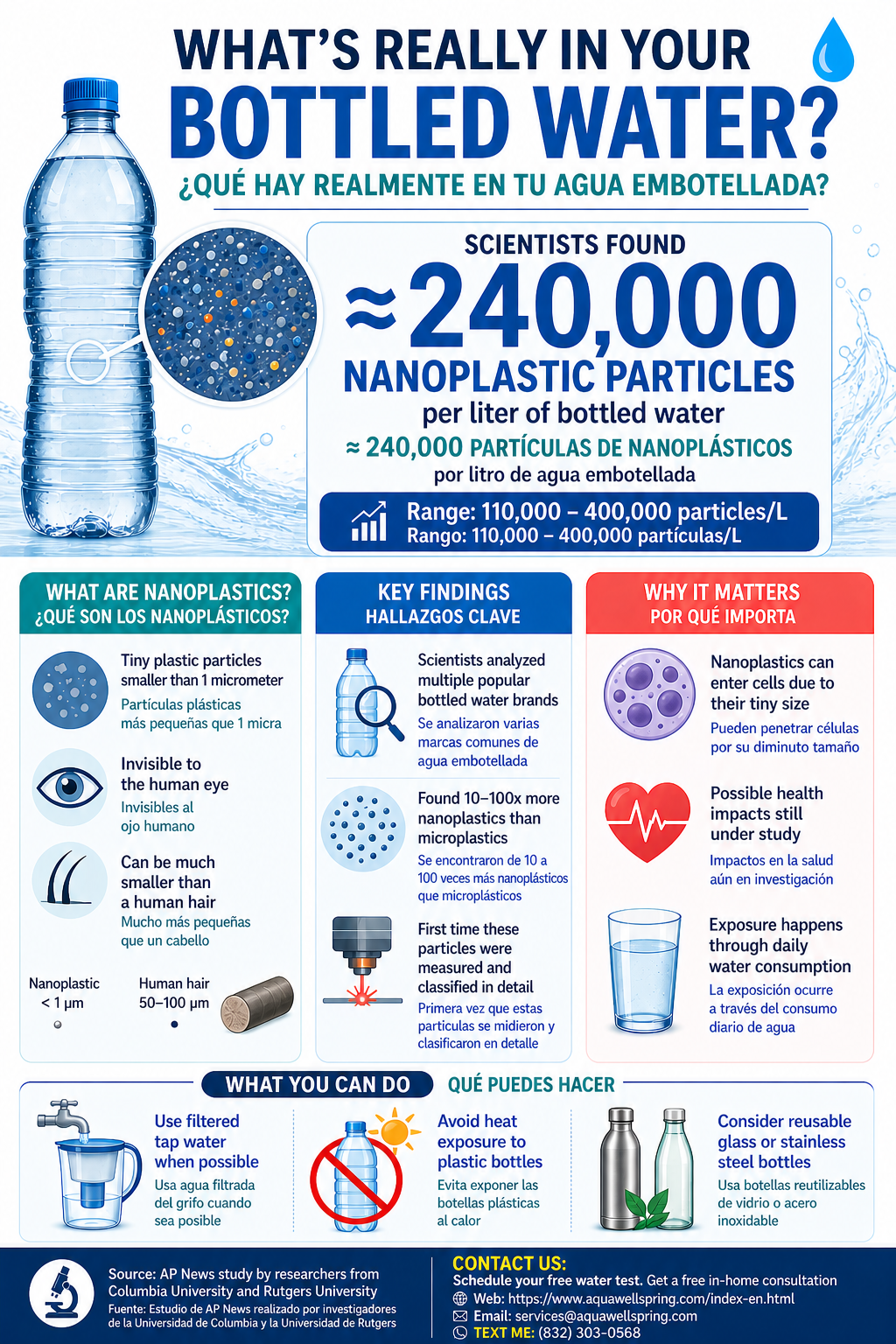
Scientists have found that bottled water contains an average of 240,000 nanoplastic particles per liter, with levels ranging from 110,000 to 400,000 particles per liter.
These particles are invisible to the naked eye—but they are present in everyday drinking water.
What Are Nanoplastics?
- Smaller than 1 micrometer
- Invisible to the human eye
- Much smaller than a human hair
Because of their tiny size, nanoplastics can travel easily through water—and potentially inside the human body.
Key Findings
- Multiple popular bottled water brands were analyzed
- 10 to 100 times more nanoplastics than microplastics were found
- First detailed classification of these particles
Why It Matters
- Nanoplastics can enter human cells
- Health effects are still under study
- Daily exposure happens through drinking water
What You Can Do
1. Use Filtered Tap Water
Reduce contaminants with a home water filtration system.
2. Avoid Heat Exposure
Heat can increase plastic particle release. Don’t leave bottles in hot environments.
3. Switch to Reusable Bottles
Use glass or stainless steel instead of plastic bottles.
Take Control of Your Water
Want to know what’s in your water?
Schedule your FREE water test today:
¿Qué hay realmente en tu agua embotellada?
Cuando compras agua embotellada, esperas pureza y seguridad. Sin embargo, estudios recientes muestran algo preocupante: el agua puede contener partículas plásticas microscópicas invisibles.
El descubrimiento
Los científicos encontraron aproximadamente 240,000 partículas de nanoplásticos por litro, con un rango entre 110,000 y 400,000 partículas por litro.
¿Qué son los nanoplásticos?
- Más pequeños que 1 micra
- Invisibles al ojo humano
- Mucho más pequeños que un cabello
Hallazgos clave
- Se analizaron múltiples marcas populares
- Se encontraron 10 a 100 veces más nanoplásticos que microplásticos
- Primera medición detallada de estas partículas
¿Por qué importa?
- Pueden entrar en las células humanas
- Los efectos en la salud aún están en estudio
- La exposición ocurre diariamente
¿Qué puedes hacer?
1. Usa agua filtrada
Reduce contaminantes con un sistema de filtración.
2. Evita el calor
El calor aumenta la liberación de plásticos.
3. Usa botellas reutilizables
Prefiere vidrio o acero inoxidable.
Controla la calidad de tu agua
Agenda tu prueba de agua GRATIS:
